Protein treatments are sold as repair. Use them enough, the logic goes, and your hair gets stronger.
That's partially true. But there's a version of the story nobody tells you the one where protein stops repairing your hair and starts damaging it instead.
Here's exactly what happens inside your hair when protein accumulates, and why it looks and feels the way it does.
How Protein Is Supposed to Work
Your hair shaft is made mostly of keratin a fibrous protein arranged in overlapping scales called the cuticle. Under a microscope, healthy hair looks like a smooth tile roof. The scales lie flat and close together.
Damage disrupts that structure. Heat, chemical processing, mechanical stress, and UV exposure all lift, chip, or crack those cuticle scales. The gaps left behind affect how hair holds moisture, how it reflects light, how it resists breakage.
Protein treatments work by temporarily depositing proteins into and onto the hair shaft. Hydrolyzed proteins (broken into small enough pieces to partially penetrate) fill some of those gaps. Larger proteins coat the surface, smoothing the cuticle layer.
Done correctly and infrequently enough, this genuinely helps. Hair feels stronger. Breakage decreases. Shine improves.
Done too often, the deposits accumulate faster than they can be shed. And that's where the problems begin.
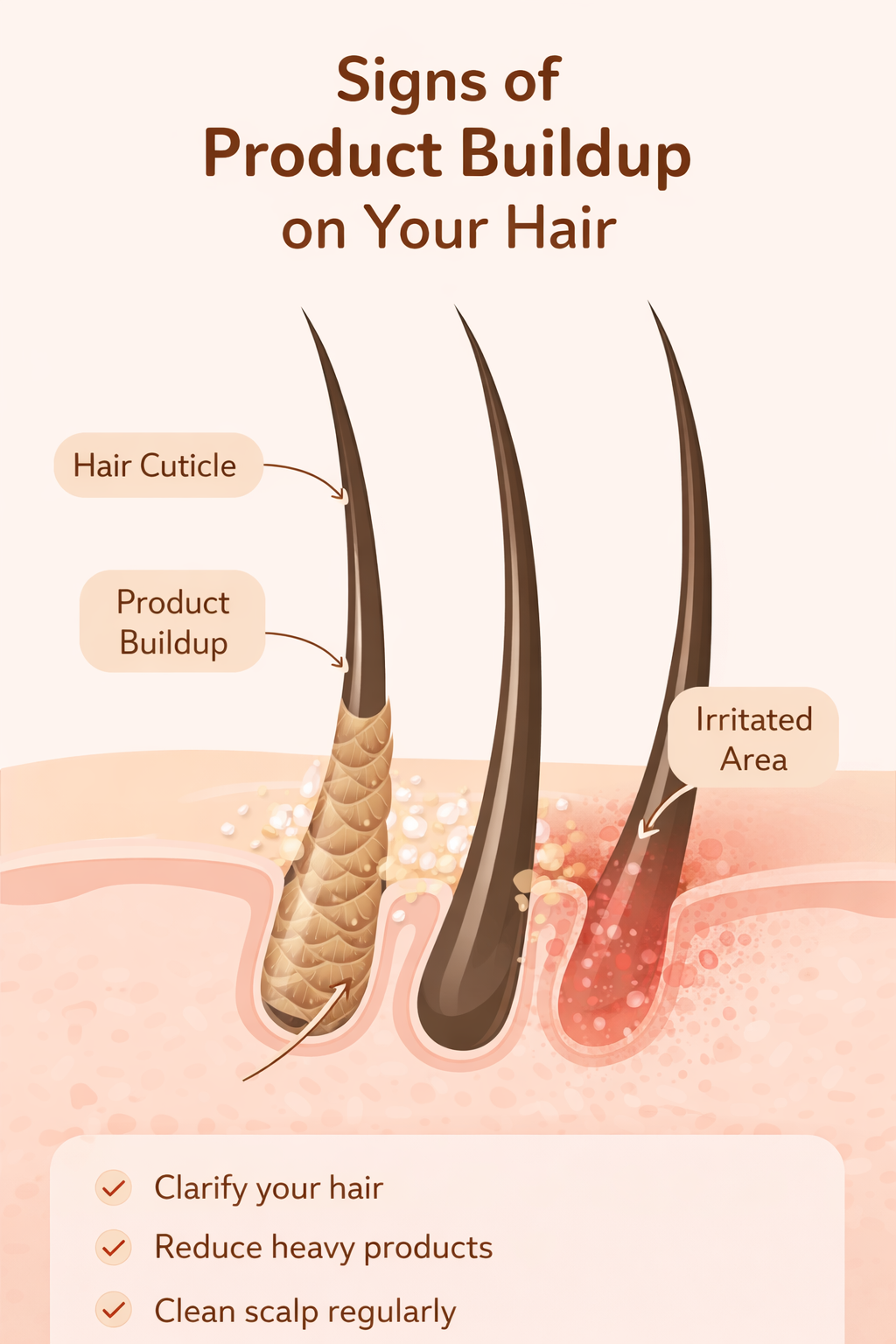
What Protein Buildup Does to Hair Structure
Imagine coating a rope with layer after layer of adhesive. Each coat makes it feel stiffer. The rope starts to lose its ability to flex. Eventually, it doesn't bend it snaps.
That's what protein accumulation does to a hair strand.
The hair shaft is designed to flex. When you stretch it, the keratin chains inside slide past each other slightly, absorbing tension. This is what elasticity means in hair the ability to stretch and return. It's what keeps hair from snapping every time you touch it.
Excess protein from repeated treatments locks those keratin chains in place. The shaft becomes rigid. It can no longer absorb tension by flexing. Instead of bending under stress, it fractures.
This doesn't happen overnight. It builds with each treatment. And because the changes are gradual, most people don't notice until the damage is already significant.
The Visible and Tactile Signs Explained
Each symptom of protein overload has a direct structural cause.
Stiffness and crunchiness Multiple protein layers have coated the shaft, preventing normal movement between fibers. The hair feels hard because structurally, it is. The protein coating has replaced flexibility with rigidity. Dullness Light reflects best off smooth, flat cuticle surfaces. Protein buildup creates an uneven, textured surface on the shaft. Light scatters instead of reflecting cleanly. Hair that should be shiny looks matte and flat. Dryness that doesn't respond to conditioner This is one of the most confusing symptoms because you're moisturizing but nothing helps. The reason: heavy protein coatings block the hair shaft the same way they block damage. Moisture cannot penetrate through a thick protein layer any more than water can soak into a wax-coated surface. You're conditioning on top of the protein, not reaching the hair underneath. Breakage without obvious cause You're being gentle. You're not heat styling. And yet your hair breaks constantly. This is the elasticity failure hair snapping because it can no longer bend. Short pieces everywhere. Breakage concentrated wherever the hair experiences tension: detangling points, hairline, areas where you clip or style. Changed curl pattern The extra weight and rigidity of protein buildup physically changes how your curl pattern behaves. Coils that were springy become stretched out or limp. Waves that were defined become frizzy. The curl isn't gone it's weighed down and stiffened. Products that suddenly stop working Your trusted deep conditioner used to make your hair feel amazing. Now it does nothing. This isn't the product changing. It's the protein barrier blocking the conditioner from reaching the shaft. The product still works it just can't get through.Which Hair Types Are Most Vulnerable
Not all hair responds to protein the same way. Some types are far more susceptible to overload.
Low porosity hair is the most vulnerable. The cuticle is tight and resistant to absorption. Proteins don't penetrate deeply instead they accumulate on the surface, building up faster with each application. People with low porosity hair can experience protein overload from a single strong treatment, or from weeks of using multiple protein-containing products simultaneously. Fine hair has less surface area per strand and less structural mass to distribute the protein load. Buildup becomes significant faster than it does on thicker strands. Hair in good condition doesn't have the gaps that protein fills. On undamaged hair, protein has nowhere meaningful to bond it just coats the surface. Healthy hair treated with frequent protein gets surface accumulation without the structural benefit. All cost, no reward. Highly processed or bleached hair is ironically both the type most helped by protein and the type most likely to overdo it. Because processed hair genuinely needs protein support, people use it more. But the porous, open cuticle also absorbs protein more aggressively, so less is still needed than people assume.The Difference Between Damage and Overload
These two things look similar but have different causes and different fixes.
Damage is structural change to the hair shaft itself lifted cuticles, broken protein bonds, altered curl pattern caused by heat, chemicals, or physical stress. It is permanent in the affected sections. The only fix is growing it out and cutting it off, while protecting the new growth. Protein overload is accumulated deposit on the shaft. It feels like damage, looks like damage, and causes similar breakage. But it is reversible. The protein coating can be removed with clarifying and replaced with moisture. Full recovery takes weeks, not years.The test: clarify thoroughly and deep condition with a protein-free moisturizing treatment. If your hair feels dramatically better within one to two wash cycles, it was overload. If it feels the same or worse, the underlying structure may be genuinely damaged.
Why Protein Overload Is So Easy to Miss Until It's Bad
Several things conspire to make protein overload hard to catch early.
Protein labeling is inconsistent. There's no universal rule about how prominently protein has to be featured on a label. A conditioner can be heavily protein-based without the word "protein" anywhere on the front of the bottle. You have to read the ingredient list carefully. Some symptoms overlap with moisture deficiency. Dryness and breakage happen with both protein overload and moisture deficiency. People experiencing protein overload often reach for more moisturizing products but those products also contain protein, making the problem worse. The initial effect feels good. The first time most people use a protein treatment, their hair feels stronger and looks better. This creates a logic trap: if one treatment helped, more treatments should help more. The deterioration that follows happens slowly enough that many people don't connect it to the protein. Product marketing doesn't help. Protein is sold as universally beneficial. "Strengthening," "fortifying," "reconstructing" these are positive words. The idea that you can overdo something marketed as repair doesn't occur to most people intuitively.What to Do About It
The fix is straightforward, but it takes patience.
Stop all protein immediately. Check every product in your routine for protein ingredients not just dedicated treatments, but leave-ins, conditioners, and stylers too. Switch everything to protein-free alternatives.
Clarify. Use a clarifying shampoo to strip buildup from the shaft and give yourself a clean surface.
Deep condition with pure moisture. Look for products with zero protein. Shea butter, aloe vera, glycerin, panthenol, and plant oils are what you want. Apply with heat if possible a heat cap or hooded dryer helps moisture penetrate where protein buildup has created resistance.
Repeat for several wash cycles. One moisture treatment won't undo weeks or months of buildup. Most people need three to five protein-free wash cycles before their elasticity returns. Do the stretch test on wet hair each time when your hair stretches before it snaps and springs back, you're recovering.
Reintroduce protein slowly and deliberately. Once balance is restored, protein has a role but the frequency should be driven by what your hair actually tells you, not a schedule. If your hair has good elasticity and isn't damaged, it doesn't need protein right now.
Deep Conditioner for damaged hair goes deeper on the recovery process if you think you're already there.The Bottom Line
Protein is not the enemy. Used appropriately on hair that actually needs structural support, at an appropriate frequency, balanced with moisture it's one of the most effective tools in hair care.
The problem is "more is better" thinking applied to something that requires balance, not volume.
Your hair shaft has a limited capacity to benefit from protein. Once that capacity is met, every additional treatment is just adding rigidity. Understanding what's actually happening inside your hair makes it much easier to stop before you get there and to recognize it quickly if you already have.
Join our Community Discussions on more about protein on hair.