You step outside. It's humid. Within minutes, your hair expands. Frizz appears. Curls loosen or tighten randomly. Definition disappears.
It feels personal. Like the air has something against your hair.
It's not personal. It's science. And once you understand the science, you can stop fighting blindly and start winning.
The Science: Hydrogen Bonds and Water
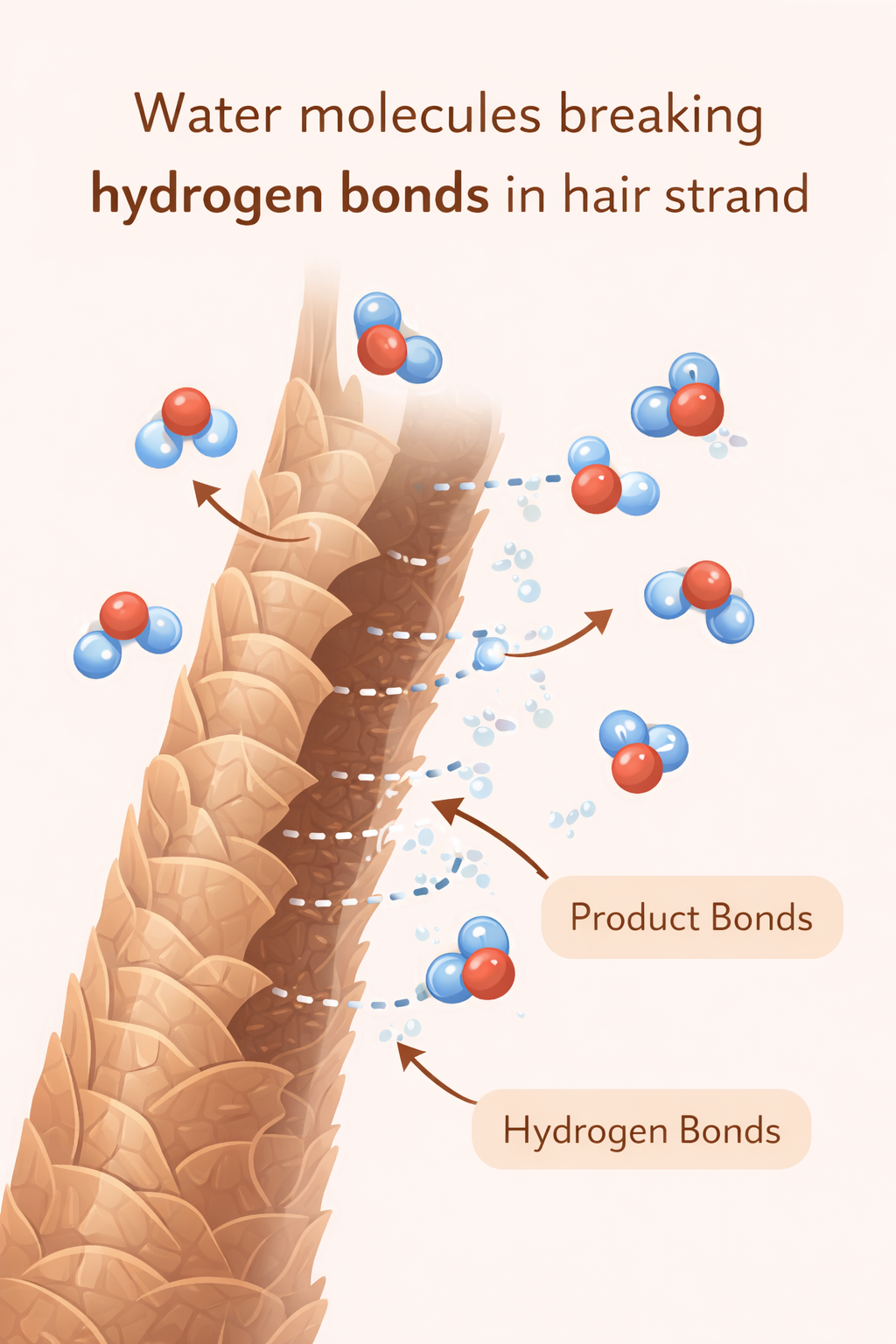
Your curl shape is held together by different types of bonds hydrogen bonds (weaker, broken by water), salt bonds (medium, broken by pH changes), and disulfide bonds (strong, broken by chemicals).
Humidity attacks the first one.
Hydrogen bonds are what keep your curls coiled. They form between protein strands in your hair. When everything's dry, they hold tight. But hydrogen bonds are water-soluble. When humidity water vapor in the air penetrates your hair, those bonds break.No bonds = no defined shape.
Your hair reverts to its natural state which, for curly hair, is frizzy chaos. Without bonds holding it together, each strand does whatever it wants.
Why Different Curl Types React Differently
Humidity doesn't treat all hair the same.
Wavy Hair (Type 2)Waves are held by fewer bonds than tighter textures. When humidity hits, waves often fall completely straight, get poofy (frizz without curl), or lose all definition. Wavy hair has less structural memory. Humidity erases it faster.
Curly Hair (Type 3) Curly hair has more bonds to break. So when humidity hits, you get some curls tightening, some loosening, frizz everywhere, and an inconsistent pattern. Your hair isn't sure what to do. Neither are you. Coily Hair (Type 4)Coily hair has the most bonds and the tightest structure. Humidity often means maximum shrinkage, frizz on top of coils, and expansion (volume) but not definition.
3C vs 4A Hair: What's the Difference? Tighter textures handle humidity differently.The Humidity Levels That Matter
Not all humidity is the same.
Low Humidity (Below 40%) Your hair might actually behave. Low humidity means less moisture in the air, so your hair retains its shape. But too low can cause brittleness. Medium Humidity (40-60%) This is the danger zone for most curly hair. Enough moisture to break bonds, not enough to saturate. You get maximum frizz with minimum benefit. High Humidity (Above 60%) Paradoxically, some curly hair improves in very high humidity. Your hair absorbs enough moisture to swell slightly, which can actually define curls. But you also get maximum frizz potential.The sweet spot is different for everyone. Some curls love 70% humidity. Some hate 50%.
The Frizz Paradox
Here's what confuses people: humidity both adds and removes moisture from your hair.
Humidity adds moisture to the air. Your hair absorbs that moisture, swelling the cuticle. That's why curls can look fuller. But that absorbed moisture also disrupts your hair's internal structure. The bonds break. The shape goes.
So you have hair that's more moisturized (good), less defined (bad), and frizzy (ugly). This is the paradox. Your hair isn't dry. It's structurally confused.
What Actually Works Against Humidity
The Barrier Approach
If humidity enters your hair, it breaks bonds. So stop it from entering.
Ingredients that create barriers:- Silicones (dimethicone, amodimethicone) controversial but effective
- Oils (especially non-penetrating ones like castor, jojoba)
- Butters (shea, mango)
- Wax-based products
These coat the hair shaft and slow moisture absorption. The trade-off: buildup. You'll need to clarify more often.
The Hold Approach
If humidity is going to break bonds, create new ones temporarily.
Ingredients that provide hold:- Gels with strong hold polymers
- Mousses
- Hairsprays
- Curl activators with PVP or similar
These create a cast around your curls. When humidity hits, the cast breaks before your bonds do. The trade-off: crunch. You'll need to scrunch out the stiffness.
The Protein Approach
Protein strengthens the hair shaft itself. Stronger hair = more resistant to humidity disruption.
Ingredients that add protein:- Hydrolyzed silk, wheat, soy, keratin
- Rice water
- Protein treatments
Stronger strands hold their shape better under stress. The trade-off: too much protein causes brittleness. Balance is key.
The 3-Step Humidity Defense System
Step 1: Start With Protein (If Needed)If your hair feels mushy or over-moisturized, a protein treatment before humidity season can help. Not required for everyone, but game-changing for some.
Step 2: Layer Products StrategicallyThe winning formula for most curly hair:
- Leave-in (light moisture, some protein ideally)
- Cream or butter (sealing, barrier-creating)
- Gel (hold, cast, protection)
Skip the cream if your hair is fine. Skip the gel if you hate crunch. Adjust based on your hair.
Why Every Hair Routine Stops Working Sometimes the problem is your layering order. Step 3: Seal and ForgetOnce styled, stop touching it. Every touch disrupts the cast and lets humidity in. Diffuse or air dry completely. Then don't touch until day 2.
The Anti-Humidity Product Guide
Look for these on labels:- Anti-humidity
- Humidity resistant
- Frizz control
- Contains silicones (if you're okay with them)
- Contains polymers (PVP, VA Copolymers)
- Glycerin high on the ingredient list (it attracts moisture)
- Hyaluronic acid (same issue)
- Water-based only routines (no barrier)
- Heavy oils without hold products
Emergency Humidity Fixes
You're out. Humidity hit. Your hair is expanding. What now?
Fix 1: The Water Reset Sometimes adding more water and a tiny bit of gel, then re-diffusing, resets the curls. Counterintuitive but effective. Fix 2: The Oil Slick A tiny drop of oil smoothed over the surface can temporarily calm frizz. Tiny drop. Too much = greasy. Fix 3: The Updo Pineapple, clip, or bun it. If it won't behave, contain it. Fix 4: Acceptance Some days humidity wins. That's okay.
Regional Humidity Reality Check
Tropical/Coastal (Constant High Humidity) Your hair is always battling. Focus on barriers and strong hold. Protective styles are your friend. Seasonal Humidity (Summer Only) You need a summer routine and a winter routine. They're different. Accept this. Arid/Desert (Low Humidity) Your problem is usually dryness, not frizz. Humidity might actually help you. Enjoy the occasional good hair day when the weather shifts.The Truth About "Humidity-Proof" Claims
No product makes your hair completely humidity-proof. Anyone promising that is lying.
What products can do: slow absorption, create temporary bonds, smooth the cuticle, and give you better odds. But on a 90% humidity day, your hair will react. The goal isn't perfection. It's better than it would be otherwise.
From Understanding to Action
Two minutes. No guesswork. Just a routine built for your real weather. Find Your Humidity-Fighting Routine →Quick Recap
- Humidity breaks hydrogen bonds = lost definition
- Different curl types react differently
- Barriers and hold products are your main weapons
- Glycerin can help or hurt depending on your climate
- No product is truly humidity-proof
- Some days you fight, some days you accept